

Reviewed · LOUVRE TICKETS & TOURS
Skip-the-Line Louvre Museum Tour with Artist
A painter-guide makes the Louvre feel smaller. This 2-hour, skip-the-line tour uses reserved entry plus an artist’s eye to help you actually see what you are looking at. I love the way the guide turns famous works into clear, human stories, from composition and lighting to how masters built a painted illusion.
Two things I especially like: you get reserved entry tickets that cut the most painful part of the day, and you travel with a certified artist-guide who can explain technique in plain language. One practical consideration, though: this tour is not suitable for wheelchair users, and the museum is full of stairs and crowds even when you use a faster entrance.
The payoff is a focused, highlights-first visit that still feels personal. You are not wandering alone through 35,000+ works with information overload. You’re in a tiny group, usually capped at no more than 6 visitors, with audio headsets available when provided, so you can hear the art talk without craning your neck.
In This Review
- Key Points I’d Prioritize
- Meeting Point: Le Kiosque des Noctambules, Across From Comédie Française
- The Skip-the-Line Moment: Pyramid Area, Reserved Tickets
- Inside the Louvre for 2 Hours: How a Painter-Guide Changes the Visit
- Mona Lisa and the Crowd Logic: Getting Close Without Losing Your Mind
- Venus de Milo and Nike: Seeing Sculpture Like You Mean It
- The Real Value: Learning Artistic Techniques, Not Just Art Facts
- Tiny Group Energy: Interactive, Efficient, and Family-Friendly
- Price and Value: Is $246 Worth It?
- Practical Stuff That Actually Matters Inside the Louvre
- Should You Book This Louvre Tour With an Artist-Guide?
- FAQ
- Where is the meeting point for this Louvre tour?
- How do I get there by metro?
- How long is the tour?
- Does the tour include skip-the-line entry?
- How large is the group?
- What language will the guide speak?
- What is included in the price?
- Is the tour suitable for wheelchair users?
- What should I bring and what is not allowed?
Key Points I’d Prioritize
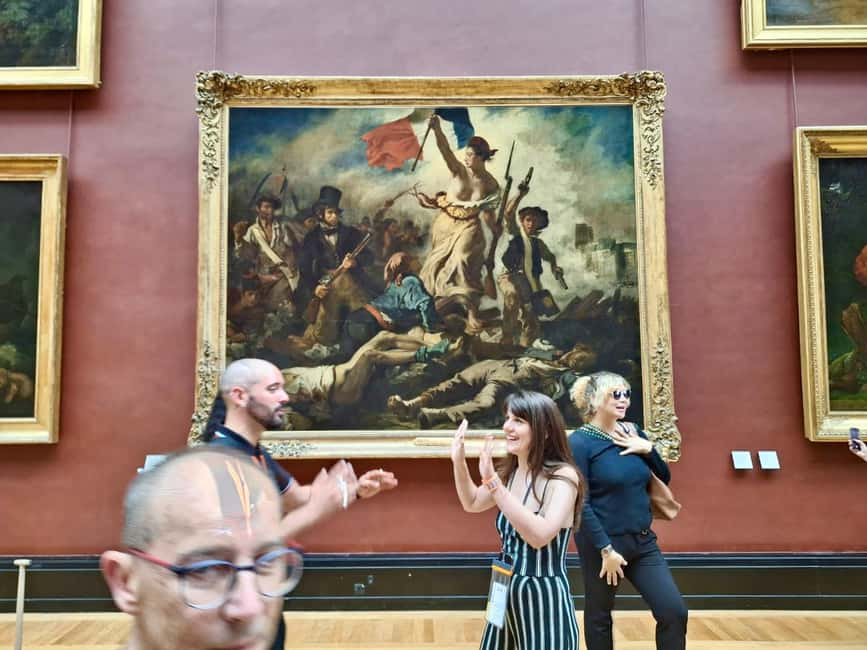
- Reserved Louvre entry via a separate entrance, so you waste less time in lines
- Certified artist-guide (painter) who explains techniques you can spot with your own eyes
- Tiny group up to 6, which keeps the experience interactive
- Up-close highlight stops like Mona Lisa, Venus de Milo, and Nike
- Audio headsets when available, which helps you stay in sync with the guide
- Guides you might hear about from past tours include Blerta, Arianna, and Assgan
Meeting Point: Le Kiosque des Noctambules, Across From Comédie Française
Here is the first thing you should know: you do not meet at the Louvre. You meet at Le Kiosque des noctambules by Jean-Michel Othoniel, a glass-bead sculpture across from the Comédie Française.
This is a good setup for two reasons. First, it avoids the confusion of everyone funneling toward the same entrance point. Second, it anchors you in a real Paris landmark zone with an easy reference point. When you get there, aim for the Palais Royal – Musée du Louvre area and use the metro: Place Colette exit from the Palais Royal – Musée du Louvre station.
Dress for short walking bursts. Even though the core tour is only 2 hours inside, you still need comfortable shoes to cover the meet-up shuffle and the museum corridors. Bring a reusable water bottle, and keep your ID handy since a passport or ID card is required, with a copy accepted.
One small tip that matters: arrive with a little buffer. Meeting at a specific sculpture means you do not want to sprint across courtyards while your group is already checking in.
The Skip-the-Line Moment: Pyramid Area, Reserved Tickets
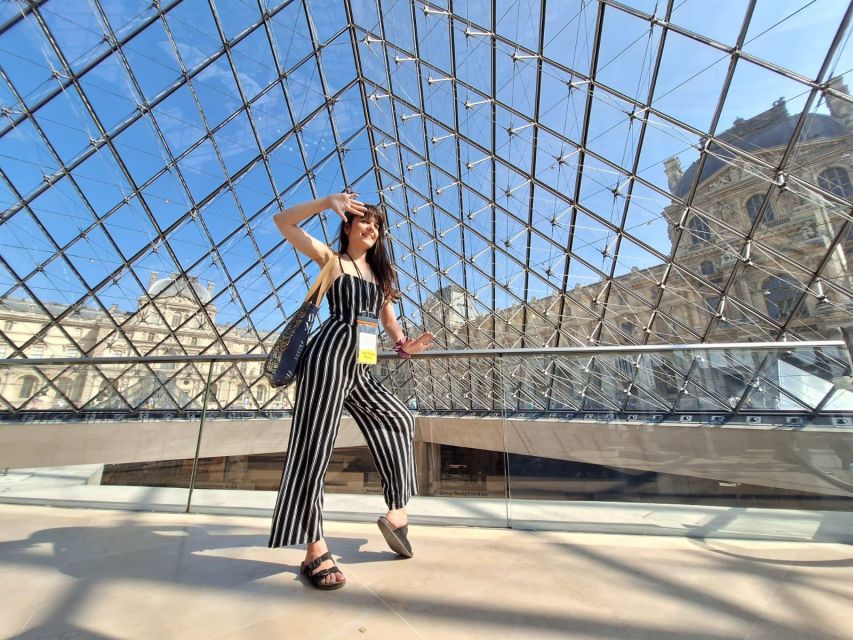
The tour then heads to the Louvre Pyramid for guided entry. The big selling point is that you get reserved tickets and use a separate entrance so you can skip the public line.
In the real world, this is not a luxury detail. At the Louvre, time is your enemy. The museum is huge, security can cause delays, and public entry lines can stretch long enough to eat your entire morning. Reserved entry is how you protect your energy for the art, not the waiting.
You also start with a guide-led moment around the Pyramid area. That matters because it sets the tone for how you will move once you are inside. A good guide helps you get oriented fast: where crowds thicken, where the best photo gaps usually appear, and how to pace your attention so you do not burn out in the first 20 minutes.
More hours budgeted for the Louvre:
- Paris: Louvre Guided Tour with Reserved Access & Boat Cruise
★ 4.3 · 16,353 reviews - Louvre Museum Masterpieces Guided Tour with Access
★ 4.5 · 12,023 reviews - Paris: Louvre Overview, Exploration tour and Reserved Entry
★ 4.1 · 10,145 reviews
Inside the Louvre for 2 Hours: How a Painter-Guide Changes the Visit

Once you are in, the format is simple and smart: guided Louvre time focused on must-see highlights, with technique-based explanations.
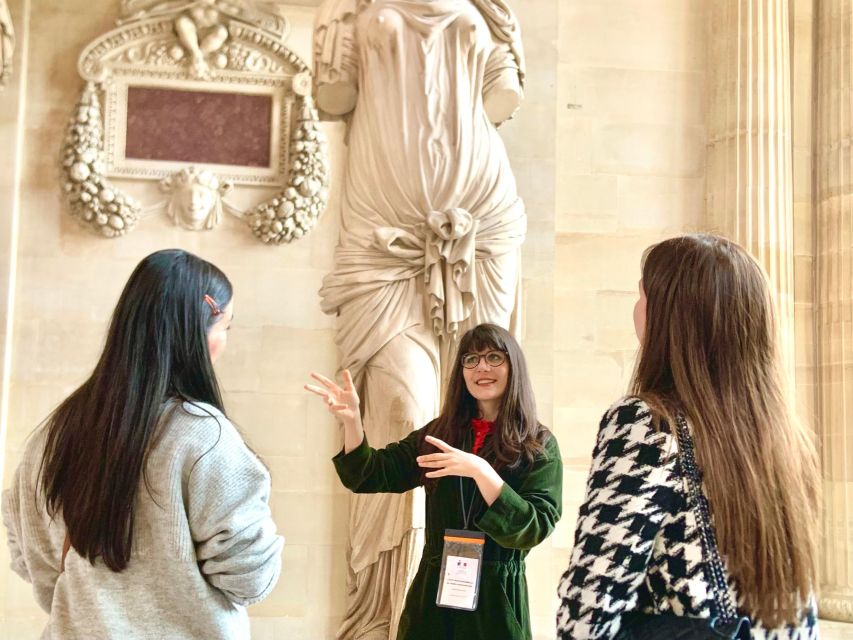
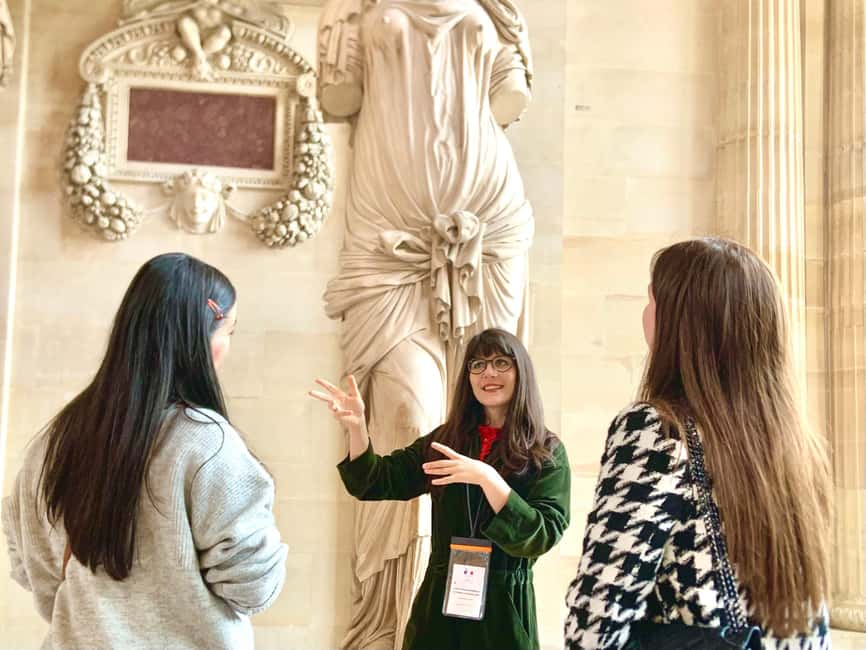
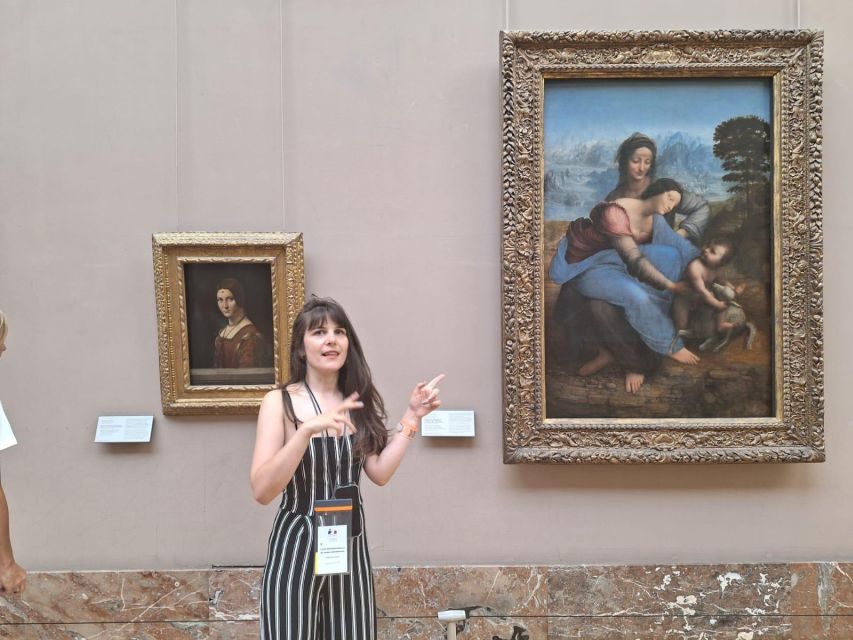
Here is what makes this tour different from a generic highlights walk. The guide is not only a historian type. They are also an artist, which changes the language. Instead of just naming works and dates, you get help looking at visible choices: proportions, light-dark contrast, brushwork style, and how an artist guides your eye.
Expect the guide to “teach you how to see” while still moving through the museum efficiently. Since the group is small, up to 6 people, you can ask specific questions without the tour turning into a lecture for 30 strangers. In the experience of past groups, guides like Blerta, Arianna, and Assgan were especially strong at answering follow-up questions and adjusting pace for kids and teens.
Another practical win is audio. Audio headsets are included, and they are used when available. In a museum, you are often surrounded by people who are talking, hovering, and pointing. Headsets let you hear the guide without pushing close enough to block someone else’s view.
One note on pacing: 2 hours sounds short, but you do not try to conquer everything. You cover fewer rooms, but you actually understand more of what you see.
Mona Lisa and the Crowd Logic: Getting Close Without Losing Your Mind
Let’s talk about the famous ones, because this tour really does center your time around the top magnets.
The guide brings you to Mona Lisa for an up-close encounter. You cannot control crowd density at the Louvre, but a small group and reserved entry do help you arrive with less pre-battle stress. The guide also helps you slow down when you reach the painting, so it is not just a quick glance through glass and on to the next stop.
What you should expect here is meaning-making. With an artist-guide, the talk usually shifts toward how the work feels and how the painting is built, not just why it is famous. You will likely spend time considering details that most first-time visitors skim: expression, subtle transitions, and how the artist creates depth.
And this is where the technique angle pays off. If you understand how light and face-shaping work, Mona Lisa stops being a name you heard in school and becomes a painted object with choices behind it.
Venus de Milo and Nike: Seeing Sculpture Like You Mean It
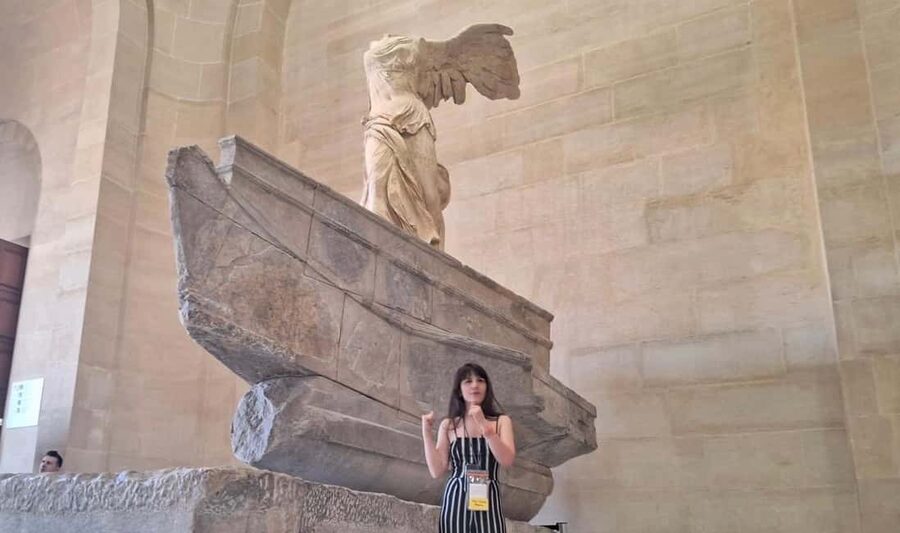
From paintings to sculpture, this tour keeps your eyes busy with masterpieces that reward looking from different angles.
You will have a stop for Venus de Milo. Since sculpture is different from a painting, the guide’s artist brain usually turns into a method: focus on form, balance, and what you can infer from posture and surface wear. Even when you cannot walk around a work freely, the guide helps you notice how the shape communicates strength, calm, or tension.
Then there is Nike. This is a great stop to mention because it is often misunderstood as just another famous statue. With a technique-minded guide, you can decode the visual language: flowing folds, movement implied by drapery, and the way the sculptor makes the body look in motion.
In past tours, guides were praised for making these stops feel personal, like you are interpreting rather than merely observing. That is the difference between a museum visit that is “I saw it” and one that is “I get it.”
More French collections worth the coat check:

The Real Value: Learning Artistic Techniques, Not Just Art Facts
The Louvre can turn into a checklist. You sprint from painting to painting, trying to remember what you read on a wall label while crowds shove past your shoulders.
This tour fights that problem by giving you a working lens. The guide focuses on artistic techniques you can understand at any level. You will learn how masters created their effects, and how you can interpret the visual choices rather than treating each masterpiece like a sealed box.
You may also hear comparisons to how artists like Da Vinci approached painting, especially when it comes to form and how reality gets translated onto canvas. The goal is not to turn you into an art student. It is to make the art feel legible.
And you do not just get technique. You get art-historical context tied to what you are looking at, from Greek antiquity to the Italian Renaissance, depending on the stop sequence and your interests. That sweep helps you connect pieces to bigger artistic ideas, so the museum stops feeling random.
This is also why families often like this tour. Kids and teens can struggle with long museum days, especially when explanations get too abstract. An artist-guide style tends to be concrete: look here, notice this, see how it is built.
Tiny Group Energy: Interactive, Efficient, and Family-Friendly

A key piece of the value is the group size. This is a tiny group limited to no more than 6 visitors, plus live guidance in Albanian, English, or French.
That small size shows up in the details:
- You can ask questions about the art piece you are standing in front of.
- The guide can adjust pacing when someone wants more time at one work.
- The tour feels more like a guided conversation than a headcount exercise.
In the past, parents praised the guide’s ability to handle children ages 11 to 16 without dumbing anything down. That is not an easy balance. When it works, everyone leaves with a different level of understanding, but the same shared experience.
If your group includes older kids or teens, you’ll probably appreciate the way the guide keeps explaining at a pace that fits real attention spans. If your group includes adults who want depth, you get that too, without making the visit feel like a seminar.
Price and Value: Is $246 Worth It?

At $246 per person for a 2-hour tour, you are paying for four things you would otherwise have to solve yourself:
- Reserved skip-the-line entry, which protects time and reduces stress.
- A certified artist-guide, which changes the type of learning you get.
- A small group cap, which makes the experience interactive and less chaotic.
- Audio headsets when available, which improves the experience inside crowded rooms.
So the question is not just whether the price is high. The question is whether you are the kind of visitor who benefits from guidance. If you only need a quick hit of the highlights, you might skip the tour and wander on your own. If you want to understand what makes these works tick, you will likely feel the value quickly.
Also, this tour can be a smart choice if you do not have many museum hours. The Louvre is too large to “figure out” perfectly on a first pass. Paying for a guided route is one way to buy clarity.
Practical Stuff That Actually Matters Inside the Louvre
Here is what you should bring and plan for, based on the tour rules.
Bring:
- Passport or ID card (a copy is accepted)
- Comfortable shoes
- Reusable water bottle
- ID copy if you plan to keep the original secure
Not allowed:
- Weapons or sharp objects
- Food and drinks
And plan for the museum reality: you are walking, and it is the Louvre. Even with reserved entry and a smart route, you should assume you will be on your feet.
Also, do not expect pickup and drop-off. You meet at Le Kiosque des noctambules and handle getting to and from the Louvre on your own.
If you want a group experience beyond the standard format, there is private group available. That can be useful if you are traveling with a group that needs a more tailored pace.
Should You Book This Louvre Tour With an Artist-Guide?
I think you should book it if you care about understanding the art, not just seeing it. The reserved entry is a genuine time saver, and the artist-guide format is what makes the difference between a crowded museum sprint and a guided learning experience.
You might skip it if:
- You only have a flexible, slow day and you enjoy wandering without structure.
- You need wheelchair access. This tour is not suitable for wheelchair users.
For most first-timers, especially families with teens, this tour is a strong value because it compresses the best stops into a tight 2 hours and teaches you how to notice what you are looking at.
If you want your Louvre day to feel like a conversation with the art, not a race through rooms, this is one of the better ways to do it.
FAQ
Where is the meeting point for this Louvre tour?
You meet at Le Kiosque des noctambules by Jean-Michel Othoniel, across from the Comédie Française. You do not meet at the Louvre itself.
How do I get there by metro?
Use the Palais Royal – Musée du Louvre metro station, then take the Place Colette exit.
How long is the tour?
The tour duration is 2 hours.
Does the tour include skip-the-line entry?
Yes. You get entry tickets to the Louvre and skip the line through a separate entrance.
How large is the group?
The tour is a tiny group limited to no more than 6 visitors per tour. Private group options are also available.
What language will the guide speak?
The live tour guide is offered in Albanian, English, and French.
What is included in the price?
Included are the Louvre museum tour (shared), entry tickets, an artist guide, and audio headsets when available.
Is the tour suitable for wheelchair users?
No. The tour is not suitable for wheelchair users.
What should I bring and what is not allowed?
Bring a passport or ID card (a copy is accepted), comfortable shoes, and a reusable water bottle. Food and drinks are not allowed, and weapons or sharp objects are not allowed.
Latest Paris entries, notes attached







Louvre Tickets & Tours, compared.

Louvre Guided Tour with Reserved Access & Boat Cruise
Read our review →
Louvre Museum Masterpieces Guided Tour with Access
Read our review →
Louvre Overview, Exploration tour and Reserved Entry
Read our review →
Louvre Museum Entry Ticket With Host and River Cruise
Read our review →
Mona Lisa & Louvre Masterpieces Tour with Reserved Access
Read our review →
Louvre Museum – Exclusive Guided Tour (Entry Included)
Read our review →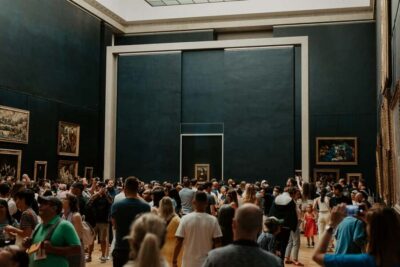
Louvre Museum Hosted Entry and Mona Lisa Audioguide
Read our review →
Louvre Access with Mona Lisa Escort or Guided Option
Read our review →This tour also appears in