
Reviewed · HISTORICAL TOURS
Guided Tour of the Historic Center of Rouen
Rouen can feel like a maze at first, but this walk helps you understand it fast. In about 1 hour 30 minutes, you move between the big landmarks of the historic center and you get clear historical context along the way.
What I especially like is the mix of practical orientation and story-driven stops. You also get an English-speaking local guide style that keeps the pace friendly, with photo moments and plenty to look at even when you are just passing by.
One thing to consider: this tour is built for seeing from the outside. If you want to go inside monuments for long stretches, you will need to plan extra time on your own.
In This Review
- Key highlights you will actually feel on this tour
- Getting Your Bearings on Rouen’s Historic Center, Fast
- Price and What You Really Get for $28.96
- Meeting at 4 Pl. de la Pucelle, Then Walking With Confidence
- Place du Vieux-Marche: Joan of Arc’s Site and a Place With Gravity
- Palais de Justice and the Secrets in Plain Sight
- Gros-Horloge: The Clock You Pass Under, With Symbols to Spot
- Rouen Cathedral Forecourt: Four Centuries in One View
- Eglise Saint-Maclou and Medieval Everyday Life
- Aitre Saint-Maclou: The Funeral-to-Life Story Place
- Abbatiale Saint-Ouen: Antiques District Energy and a Monk Legend
- What the Guide Style Brings to the Walk in English
- What This Tour Does Not Do, and Why It Matters
- Timing, Weather, and How to Set Yourself Up
- Who Should Book This Tour (and Who Might Skip It)
- Should You Book This Guided Historic Walk?
- FAQ
- Is the tour offered in English?
- How long is the guided walk in Rouen?
- Is it a small group?
- Do we enter the monuments during the tour?
- Where does the tour start and end?
- What if the weather is bad?
Key highlights you will actually feel on this tour
- Photo-stop pacing that keeps the 90 minutes moving but never frantic
- Joan of Arc at Place du Vieux-Marche, with the stake site and a dedicated church to anchor the story
- Big sightline landmarks like Gros-Horloge and Rouen Cathedral, explained without requiring entries
- Small group size (max 16), which makes questions in English feel normal
- Stop-by-stop medieval focus, especially around Saint Maclou and Aitre Saint-Maclou
- Local guide energy, with guides named Elodie and Emilie showing up in past departures
Getting Your Bearings on Rouen’s Historic Center, Fast
Rouen is the kind of city where you can accidentally walk past major meaning. This guided walk solves that problem by threading together the places that shaped the city, not just the places that photograph well.
You start near Pl. de la Pucelle and you finish close to Saint-Ouen Abbey Church, near Rouen City Hall. That means the whole experience works like a launch pad: you learn what you’re looking at, then you can roam the rest of the day with better instincts.
The pace also matters. You are not stuck at one spot for an hour. Instead, you get repeated “pause and look” moments so your brain keeps connecting buildings to eras.
Price and What You Really Get for $28.96
At $28.96 per person for about 90 minutes, this is priced like an efficient orientation tour, not an all-day deep study. For the money, you’re paying for a guided route that covers multiple top sights, plus short explanations that help you notice details you would otherwise miss.
Another value point: the tour uses a mobile ticket, so you are not juggling paper. It also runs in English, which matters in Rouen because a guided explanation can turn stone facades and symbols into something you understand quickly.
What you are not paying for is monument entry. That’s not bad, but it changes the value math. If you want inside visits, you may end up spending extra time and money later to satisfy that itch.
More centuries, footnoted:
- Historic Bayeux Daily Group City Tour In English 2 hrs (Apr-Sept)
★ 5.0 · 220 reviews - Rouen: Guided Tour of the Historic Center
★ 4.8 · 145 reviews - Small Group Guided Tour of the Secret History of Rouen
★ 5.0 · 68 reviews
Meeting at 4 Pl. de la Pucelle, Then Walking With Confidence
Your tour starts at 4 Pl. de la Pucelle, 76000 Rouen at 10:30 am. The meeting point is central and easy to find, and it helps that you are also near public transportation. For first-time visitors, this alone can be the difference between a smooth start and a stressful one.
You end near Saint-Ouen Abbey Church and close to Rouen City Hall, with about a five-minute walk to the historic center area. In real terms, it means you can finish and keep exploring without having to transfer across town.
Also, the group size caps at 16 people. That matters for sound and attention. With a smaller crowd, questions land faster and you get better chances to hear the guide’s points even when you’re stopping for photos.
Place du Vieux-Marche: Joan of Arc’s Site and a Place With Gravity
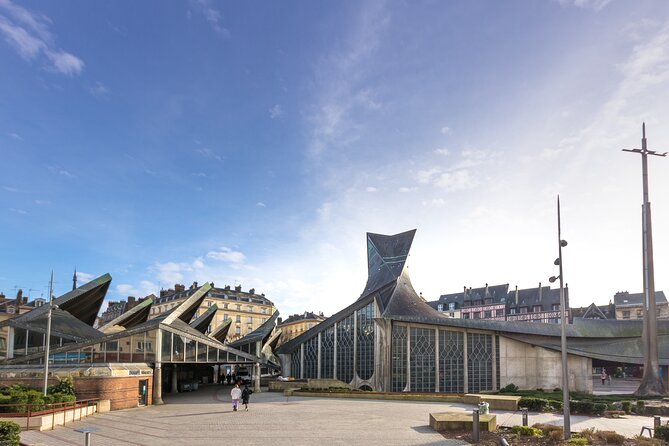
The first stop is Place du Vieux-Marche, where the story of Joan of Arc’s last moments is anchored in the landscape. You’ll see the stake site and the church dedicated to her, and the guide ties the scene to the bigger arc of Rouen’s past.
This is one of those moments where the city becomes more than architecture. The square is compact, so you can actually take in the setting without feeling like you need a museum timeline to follow along.
Time is short here, about 10 minutes. That’s perfect for first contact, but if this subject is a top priority for you, you may want to come back later for a slower look.
Palais de Justice and the Secrets in Plain Sight
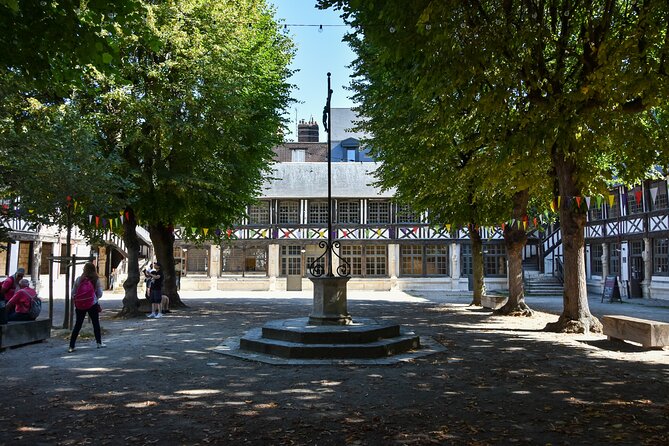
Next you’ll look toward the Palais de Justice, where the guide explains the history of its construction and what makes it interesting. Even without entering, you can still learn how big civic buildings carry layers of time.
This stop is also a useful break from pure “tourist landmark mode.” Instead of just saying this is important, the guide gives you cues for what to notice, like how the building relates to the city and why it took the shape it did.
You get about 10 minutes at this stop. That’s enough for orientation, not enough for architecture nerd mode. If you love deep inspection, treat this as a first prompt, then add your own reading or a return visit.
More Things to Do in Normandy

Gros-Horloge: The Clock You Pass Under, With Symbols to Spot
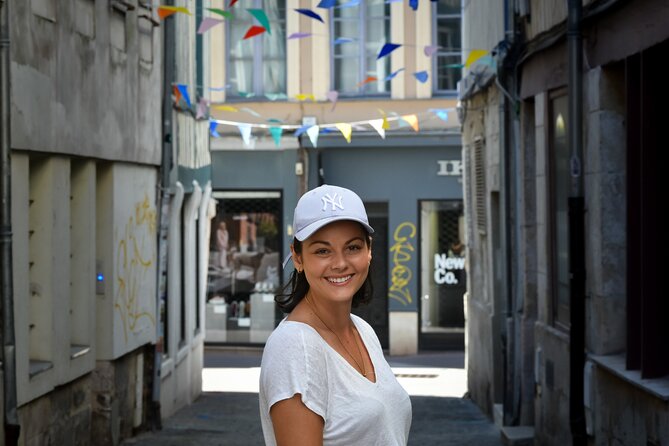
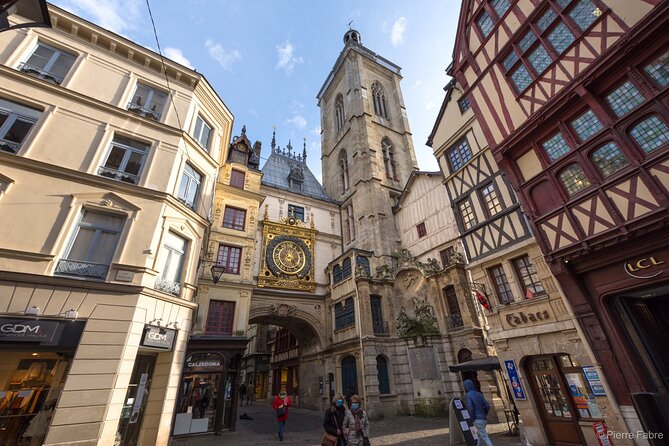
Then comes Gros-Horloge, the big clock you pass under through its arch. The fun part is that the guide doesn’t treat it like a static postcard. You’re invited to go back in time through the clock’s symbols and the meaning behind what you’re seeing.
This stop is short, around 10 minutes, but it’s designed to land. You’ll leave with a “wait, I noticed that” feeling, because the guide points out details you can spot again when you’re walking independently.
If you are the type who loves quirky, visual explanations, this is usually the stop that makes the tour feel fun instead of strictly educational. And yes, it’s easy to frame a photo while staying oriented to the story you just heard.
Rouen Cathedral Forecourt: Four Centuries in One View
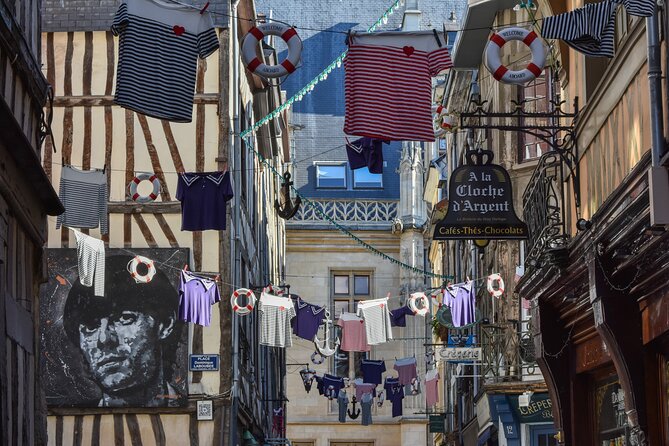
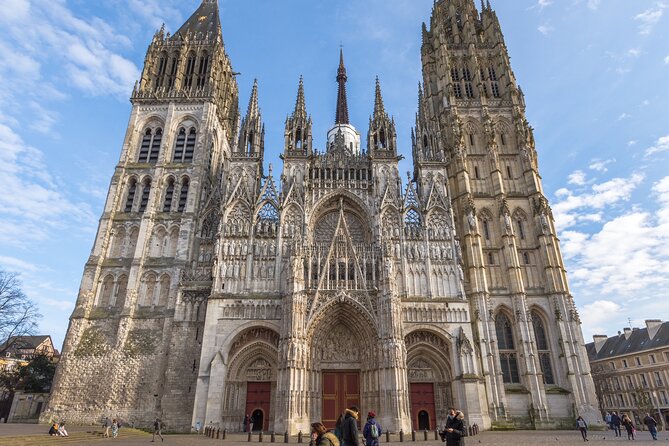
At Cathedrale Notre-Dame de Rouen, you’re set up in the forecourt to admire how the cathedral developed across centuries. The guide points out architectural changes and helps you understand why the building looks the way it does today.
You also get a side angle that is surprisingly engaging: talk about the impressionist current. Even if you are not an art specialist, this gives your eyes a second lens, so you can look at the cathedral and think about how artists responded to it.
This stop also runs about 10 minutes and stays outside. The upside is that you keep the pacing. The downside is that you won’t get the full experience if your dream is stained glass or interior details.
Eglise Saint-Maclou and Medieval Everyday Life
Now the tour turns toward how people lived, not just what rulers built. At Eglise Saint Maclou, the guide helps you approach the living conditions of the time and understand what daily life looked like in medieval Rouen.
This is a smart shift. Many walking tours stay stuck on royalty and wars. Here, you get a different angle on the city, which makes the whole trip feel more human.
You’re at this stop for about 10 minutes. That’s a solid amount of time for outside observations and story context, but you might find you want more detail once you start thinking about everyday survival rather than famous events.
Aitre Saint-Maclou: The Funeral-to-Life Story Place
Next is Aitre Saint-Maclou, a stop with a short time window of about 5 minutes. The key idea is how the funeral activity gave way to a real place of life, and the guide explains the transition in a way that helps you understand why the space matters.
Even in five minutes, this kind of story can stick. It changes how you read the area. Instead of treating it as a stop on a route, you start seeing it as a functioning social space shaped by ritual and necessity.
One practical note: because the stop is brief, pay attention to what the guide emphasizes. If you miss the main explanation, the place may feel like just another historic corner. If you catch it, the short visit feels like it has real payoff.
Abbatiale Saint-Ouen: Antiques District Energy and a Monk Legend
The final stretch brings you to Abbatiale Saint-Ouen, with a quick 5-minute stop that wraps the walk with legend. The guide shares the legend of the monk of the Abbey of Saint-Ouen, and the atmosphere here ties neatly into the surrounding antiques district vibe.
This is a nice closing move because it gives you something memorable beyond dates and construction. Legends are how old cities stay alive in the mind, and the guide uses that to finish on a human note.
You also end near where it’s easy to keep walking on your own. Since Saint-Ouen is one of the big anchors in the area, you can use the stop as a springboard for your next self-guided wander.
What the Guide Style Brings to the Walk in English
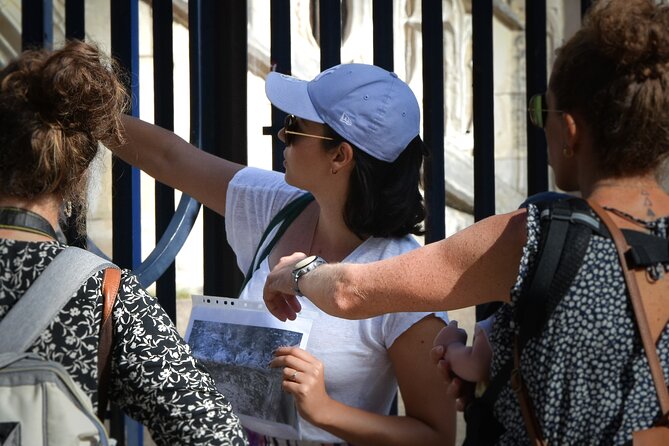
The tour’s tone depends heavily on the guide, and the evidence in past departures is consistent. Guides named Elodie and Emilie have been mentioned, and both are described as engaging, clear in English, and able to answer questions without dragging the group.
One of the most useful guide skills here is pacing information. You get historical context with enough chronological structure to orient you, without drowning you in endless dates or names. That is exactly what first-time visitors need, and it’s also great if you want to keep moving while still feeling informed.
Elodie is specifically noted as a local guide who lives in Rouen and is connected to Giverny, where Monet lived. Whether or not your departure is guided by her, this points to something important: you are walking with someone who knows how to connect Rouen to broader French culture, not just recite facts.
What This Tour Does Not Do, and Why It Matters
This walk does not include entering the monuments. That means your experience is built around exterior views and guided explanations at each stop.
If you want to step inside the cathedral for a long time, or if you want deep entry-level immersion in tombs, cloisters, or galleries, you will probably feel slightly capped. The tour’s strength is getting you oriented across many landmarks quickly. Its limitation is that it’s not meant to replace a longer, monument-by-monument visit day.
That said, if you are short on time, this style is often the best deal. You leave with a mental map and a list of what to return to, which is exactly what you need on a first trip.
Timing, Weather, and How to Set Yourself Up
You start at 10:30 am, so it works well for a morning plan that leaves you time to explore after. The experience also requires good weather. If the forecast looks grim, plan to be flexible, because you might need a different date if conditions are not right.
Wear comfortable shoes. You’re doing a walking route with multiple stops, and the city streets can vary in surface and slope. If you care about photos, bring what you’d normally bring for city walking, and keep your phone ready during the guide’s photo-friendly pause points.
The average booking window is about 29 days in advance, which is a clue that this is a popular way to see Rouen efficiently. If you travel in peak periods, it’s smart to lock it in earlier.
Who Should Book This Tour (and Who Might Skip It)
I’d book this if you fit one of these categories:
- You’re visiting Rouen for the first time and want a fast orientation.
- You have limited time and still want to hit the main highlights.
- You want a guide in English who can explain what you’re seeing without making it a lecture.
- You prefer a small group setting where questions are easy to ask.
I’d think twice if:
- You want to enter monuments as a core part of the plan.
- You’re looking for a long, slow museum style visit with lots of inside time.
- You want a highly technical architecture tour with extended time at one site.
Should You Book This Guided Historic Walk?
Yes, if your goal is to understand Rouen quickly and get moving with confidence afterward. The tour’s biggest win is that it gives you context at the exact places where that context matters, without forcing you into long entries or complicated planning.
If you want to build a balanced day, this is a strong starting move. You’ll cover major landmarks like Place du Vieux-Marche, Gros-Horloge, and Rouen Cathedral from outside, then finish near Saint-Ouen so you can keep exploring on foot.
My practical advice: use this tour to learn the stories and spotting cues, then return later to the sites that spark your curiosity. That is how you turn a short guided walk into a full Rouen experience.
FAQ
Is the tour offered in English?
Yes. This experience is offered in English.
How long is the guided walk in Rouen?
It lasts about 1 hour 30 minutes.
Is it a small group?
Yes. The tour has a maximum of 16 travelers.
Do we enter the monuments during the tour?
No. The tour does not plan to enter the monuments. Some stops are described as free, but the tour itself is focused on seeing from outside.
Where does the tour start and end?
It starts at 4 Pl. de la Pucelle, 76000 Rouen, France and ends near Saint-Ouen Abbey Church at Pl. du Général de Gaulle, 76000 Rouen, France.
What if the weather is bad?
The experience requires good weather. If it’s canceled due to poor weather, you’ll be offered a different date or a full refund.
Latest Normandy entries, notes attached






Historical Tours, compared.

Louvre Museum Entry with History of Mona Lisa
Read our review →
Vieux Lyon Cultural & Historical Walking Guided Tour (English)
Read our review →

Toulouse Food & History Tour with a Chef (in English)
Read our review →
Small-Group Full-Day Tour of Côte de Nuits, Côte de Beaune Vineyards and Beaune Historical District
Read our review →
This tour also appears in