
Reviewed · MONTMARTRE WALKS
Paris: Montmartre Macaron Baking Workshop
A macaron workshop in Montmartre feels oddly relaxing. In a small shop near 175 Rue Legendre, I like how the class turns a tricky French cookie into steps you can actually repeat at home. You work with an Italian meringue method, then get hands on with piping, decorating, and filling, guided by instructors like Kanika and Vouthy.
What I love most is the focus on technique over luck. You start with the ready-to-go tant pour tant ingredients, then learn the exact timing behind macaronage (the mixing step that gives you that smooth, “feet” forming shell). You also take home 15 macarons in a special box, filled with a rich raspberry or mango-passion ganache demo.
One consideration before you book: the class moves quickly, and you may not get a printed recipe to take home during the session. One guest noted they were pointed to Instagram for notes, so bring your phone and a notebook if you like to copy down details.
In This Review
- Key things to know before you go
- Finding Maca’Rong in Montmartre (175 Rue Legendre)
- Tant pour tant setup: why your ingredients are pre-planned
- Italian meringue method: the technique that reduces guesswork
- Macaronage and piping: the steps that make or break your shells
- Designing with a double nozzle, then filling your choices
- What you take home: 15 macarons and the special box
- Price and value: is $150 a fair deal?
- Who this is best for, and who should skip it
- Timing your workshop day in Paris without stress
- Should you book the Montmartre Macaron Baking Workshop?
- FAQ
- How long is the Paris Montmartre macaron baking workshop?
- How many people are in the group?
- What language is the workshop taught in?
- What do I take home?
- Is it possible to watch without participating?
- Is the workshop suitable for lactose intolerance or wheelchair users?
Key things to know before you go
- Italian meringue for more reliable shells instead of guessing with timing
- Hands on piping practice so you learn how to handle the batter, bag, and templates
- Personal designs with a double nozzle for shells that look like you made them on purpose
- 15 macarons to take home in a provided box, plus bags for packing
- Raspberry or mango-passion ganache demo that teaches you filling flavor, not just assembly
- Small group, max 6 means you can ask questions and get feedback
Finding Maca’Rong in Montmartre (175 Rue Legendre)
Your experience starts at 175 Rue Legendre, inside the Maca’Rong shop on the ground floor. This matters because you are not wandering around Montmartre hunting for a “mystery classroom.” You can arrive, check in, and settle into the workshop setup fast.
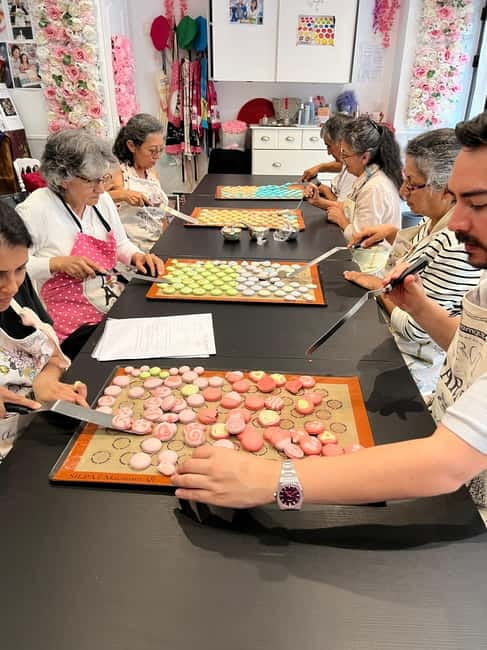
The class is capped at a small group of 6, so you are not stuck watching from the sidelines. The workshop also requires a reservation for everyone attending, and it is not possible to stay just to observe. If you like learning by doing, that structure is a plus. If you were hoping for a calm background activity while someone else bakes, this one is hands on by design.
Expect a friendly, shop-based atmosphere rather than a big, formal cooking school. Reviews also hint that the instructors keep things upbeat and humorous, which helps when a macaron workflow is, by nature, fussy and timing sensitive.
Tant pour tant setup: why your ingredients are pre-planned
Once you are inside, the workshop gets right to the prep. You are set up with bowls of tant pour tant, the classic macaron approach that mixes almond flour and powdered sugar by weight. That part sounds basic, but it is exactly why macarons are easier in a class like this: you are not trying to measure perfectly while learning the hardest part.
This is also where you start building the “feel” you need later. You see how the dry mix behaves, how it combines with meringue, and what kind of batter texture the instructor is aiming for. That gives you a reference point. When you get to macaronage, you are not learning from zero.
Also, the class includes tea, coffee, and macarons during the session. That means you can fuel up while you learn, rather than arriving hungry and getting annoyed while your meringue stage demands attention.
More climbs through Montmartre:
- Montmartre Hidden Gems and Scenic Highlights Walking Tour
★ 5.0 · 2,684 reviews - Montmartre Hill French Gourmet Food and Wine Tasting Walking Tour
★ 5.0 · 2,588 reviews - Paris: Montmartre Highlights Walking Tour with a Local Guide
★ 4.9 · 2,318 reviews
Italian meringue method: the technique that reduces guesswork
The center of the workshop is learning the Italian meringue method for foolproof macaron shells. Compared to other methods, Italian meringue is often seen as more efficient because the hot sugar syrup helps stabilize the egg whites. In plain terms, it can help you reach the right meringue structure without as much trial and error.
You are taught a slightly technical approach, but the class keeps it practical. You do not just hear the theory. The instructors guide you through the logic of the steps so you understand what changes when your meringue is at the right stage. That matters because macarons fail for specific reasons, like meringue that is under or over-whipped, or a batter mix that is too thick.
A helpful detail: the instructor also explains alternative techniques so you see the bigger picture. You do not leave thinking one method is the only way; you understand why Italian meringue is being used here.
In reviews, guests mention instruction that targets common trouble spots, including shell issues like cracking and the so-called bec d’oiseau problem. Even if you have never heard that term, the value is clear: you get targeted feedback on what to watch during the process, not just a generic “mix until smooth.”
Macaronage and piping: the steps that make or break your shells
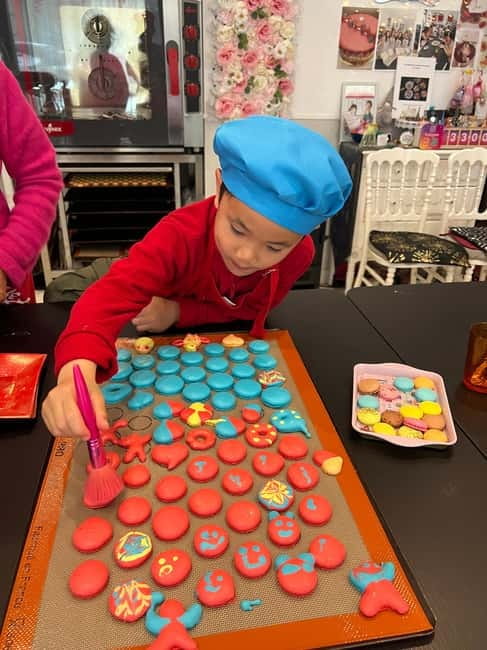
Macaronage is the moment you earn the right texture. It is also the step that scares people. In this workshop, you learn it step by step: once the dough begins to look glossy and more fluid, you keep going just enough to reach the consistency needed for piping.
In other words, you are learning the difference between batter that is too thick (won’t spread smoothly) and batter that is too thin (can collapse). The instructor’s guidance on “when it shines” helps you connect visual cues to texture, which is exactly what you want for home baking.
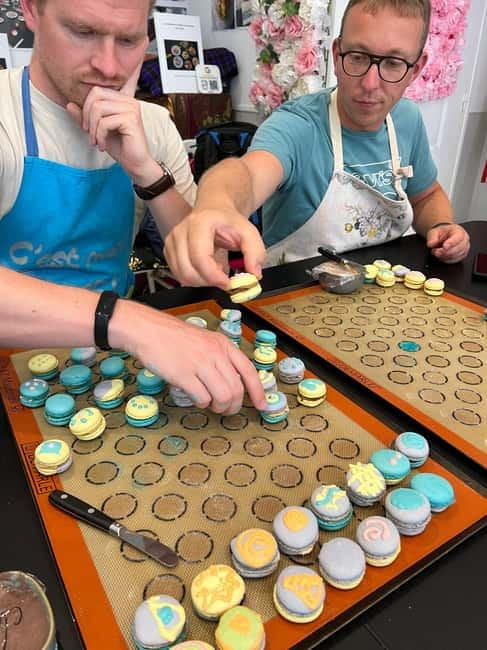
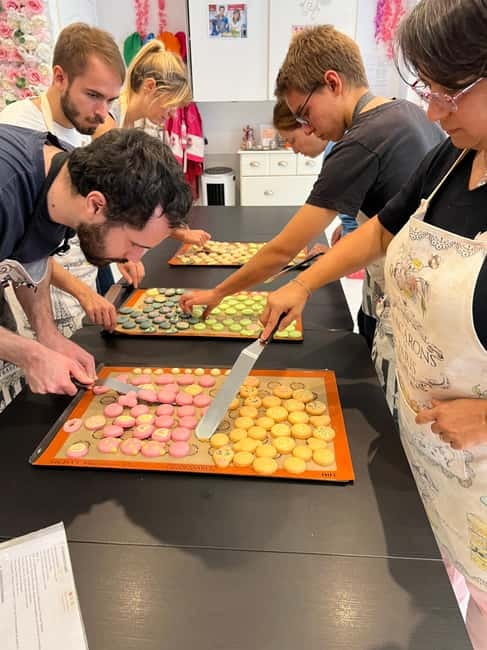
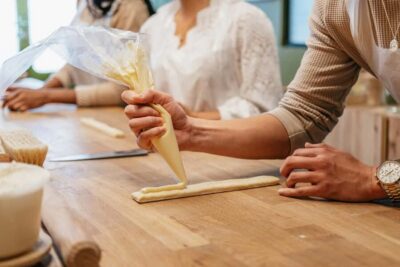
Then comes piping. You get a lesson on how to fill and handle the piping bag so you waste less batter and pipe more evenly. After that, you practice using round templates before you move into the more creative stage.
This practice part is key. Even if you have decent hand skills, macarons demand consistency across multiple shells. By practicing on templates first, you build muscle memory before you start decorating in earnest.
And yes, the pacing is fast. The class is designed to fit everything into 2 hours, and that is part of the charm. Just be ready to pay attention the whole time.
Designing with a double nozzle, then filling your choices
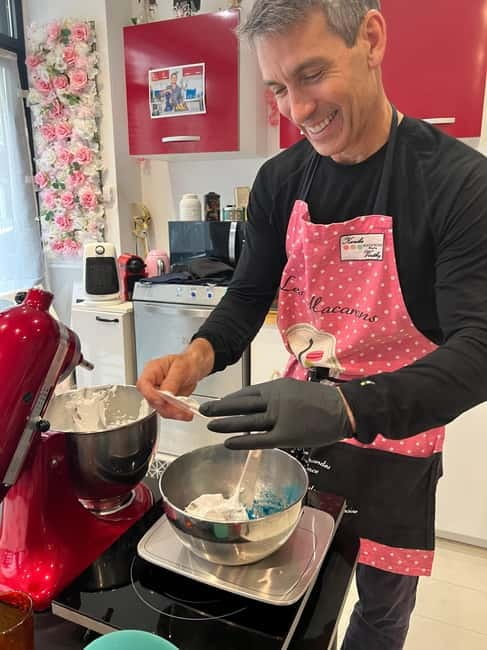
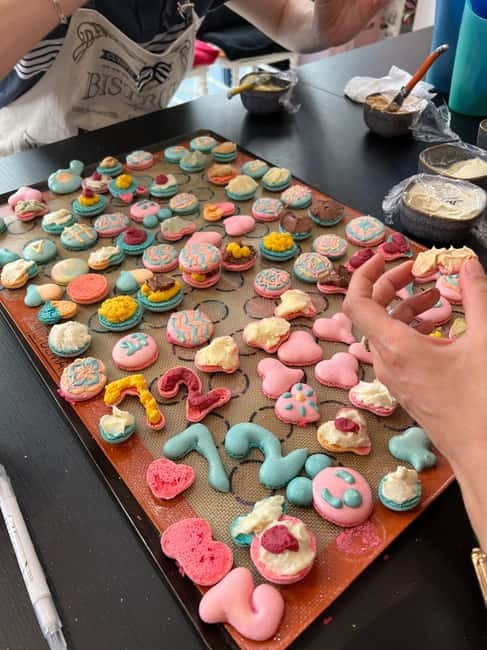
One of the most fun parts is personalization. Once the shell base work is done, you learn how to embellish using a smaller double nozzle. That’s how you get distinct patterns instead of one simple piped circle.
You are not just told to pick a color. You are taught a method for applying designs cleanly, which helps your macarons look intentional even if you are not an artist. The outcome is that each person ends up with a set of 15 personalized macarons.
Filling is where flavor turns into the real “Paris bakery” feel. You are given filling options during the class, and the workshop includes 10 fillings. While the shells bake, you get a demo on making a rich ganache, specifically raspberry or mango-passion, and how that filling lifts the final taste.
If you are the type who cares about the last bite, pay attention here. Ganache is not just sweet filling. It changes the texture balance between shell crunch and center softness.
Also, some people mention tasting other items during the session, like yuzu lemonade and cheese. Those extras are not the main event, but they fit the overall vibe: a cozy shop lesson, not a sterile classroom.
More piping bags and patient shells:
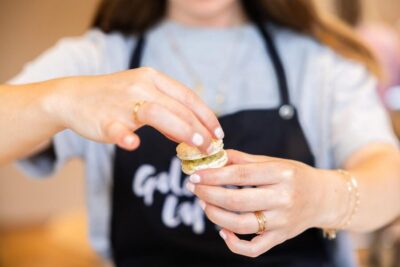
What you take home: 15 macarons and the special box
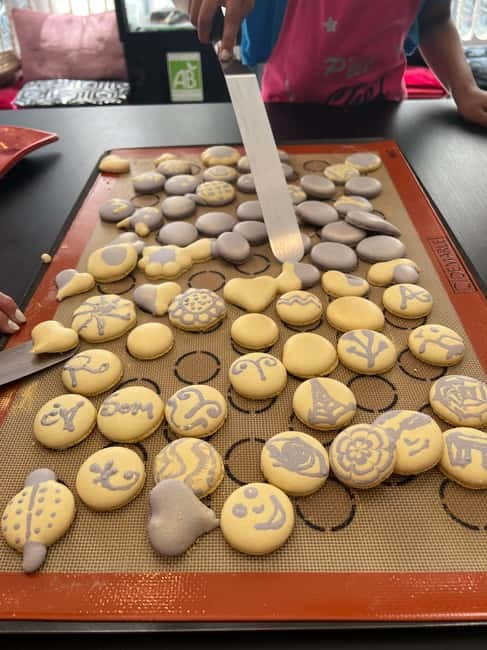
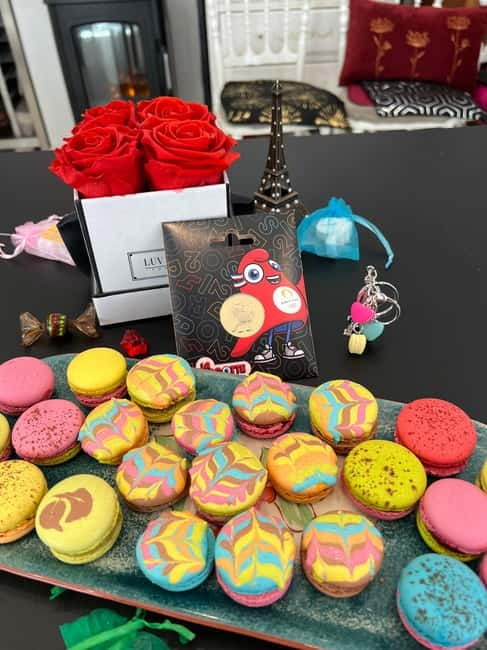
You leave with the core reward: your own macarons. The included takeaway is 15 macaroons to take home, packed in a special box, plus the bags needed for transporting them.
For me, this is where value becomes obvious. You are not paying for a lecture. You are paying for ingredients, instructor time, and the equipment plus the time needed to bake and package your results. In a city where a small box of macarons can be expensive, leaving with a full box you made yourself is a strong deal.
One more subtle benefit: making something that requires both timing and technique is the fastest way to understand why certain Paris desserts taste the way they do. You do not just learn a recipe. You learn the “why,” which helps if you want to try again later.
Price and value: is $150 a fair deal?
At $150 per person for about 2 hours, this workshop is not a budget activity. But it can still feel like solid value if you care about hands-on learning and getting results.
Here is what you get for the price, based on what is included:
- Baking class and guided instruction
- Tea, coffee, and macarons during the session
- A chef sharing a secret recipe
- 15 macarons to take home in a special box
- 10 fillings
- Packaging bags for your macarons
The biggest value driver is the take-home output. If you were just buying macarons, you would pay for finished goods with no instruction. This is a hybrid: you get a practical skill lesson plus a satisfying edible souvenir.
Also, the class size is small (up to 6). That usually means you can get corrections quickly, rather than waiting your turn behind a large group.
Is it worth it if you only want to try one flavor and you do not plan to bake again? Maybe not. But if you want to learn the Italian meringue method and actually understand macaronage and piping, the cost starts to make sense fast.
Who this is best for, and who should skip it
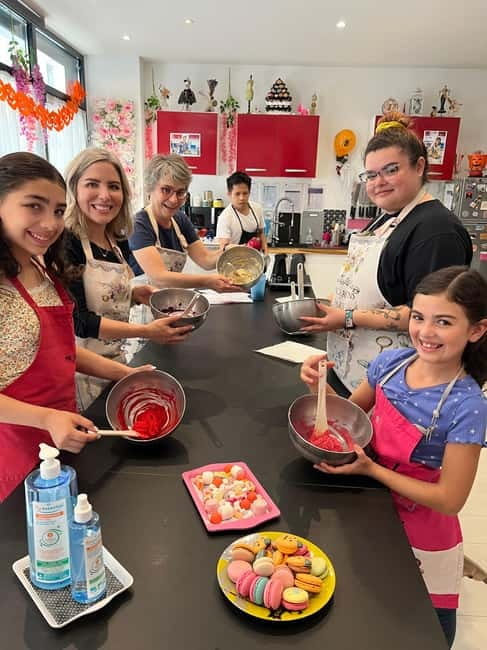
This is a good fit if you like interactive food experiences and you want to learn something that feels very Paris. The workshop is also taught in English and French, which helps if your group includes different language levels.
It is also a strong choice for families, with many reviews describing kids enjoying the process. One thing to note from the activity rules: it is not suitable for children under 6. Reviews also suggest it can work well for ages around 9 and up, but you should still follow the official age limits.
Skip it if any of these apply:
- Wheelchair users (not suitable)
- People with food allergies (not suitable)
- People with lactose intolerance (not suitable)
- Babies under 1 year (not suitable)
- You need to bring oversize luggage (not allowed)
One more practical note: because the class is hands on from start to finish, you should show up ready to participate. No watching. No hovering. This is not a sit-and-snack kind of activity.
Timing your workshop day in Paris without stress
The meeting point is in the same area you would associate with Montmartre, so you can plan the workshop as a reason to be out and about in that neighborhood. One guest mentions the walk to Montmartre being about 20 minutes, which makes it easy to build a simple plan: workshop first, then lunch or sightseeing after.
Because everything takes about 2 hours, aim to schedule it so you still have a buffer before dinner. You will be busy in the middle, and you will also want time to enjoy your finished box later.
Also, pack light. You cannot bring oversize luggage, so keep it simple: day bag, water, and anything you need for notes.
Should you book the Montmartre Macaron Baking Workshop?
I think you should book if you want a real skills workshop, not just a cute tasting. You get Italian meringue instruction, you practice piping and learn decorating with a double nozzle, and you leave with 15 macarons you made yourself. It is hands on, fast, and designed for small groups, which keeps the learning focused.
I would hesitate if you specifically need a slow-paced class, or if you strongly prefer a printed recipe handed out for note-taking. One guest said they were directed to get the recipe via Instagram instead of receiving a printout. If that would annoy you, bring your own notebook and be ready to capture key steps.
If you love baking, or even if you have only ever bought macarons and wondered how they work, this is one of the better Paris food experiences because the payoff is immediate and edible.
FAQ
How long is the Paris Montmartre macaron baking workshop?
The workshop lasts 2 hours.
How many people are in the group?
It is a small group limited to 6 participants.
What language is the workshop taught in?
The instructor speaks English and French.
What do I take home?
You take home 15 personalized macarons in a special box. The class also includes 10 fillings, plus bags for your macarons.
Is it possible to watch without participating?
No. Everyone at the workshop must have a reservation, and it is not possible to stay just to observe.
Is the workshop suitable for lactose intolerance or wheelchair users?
No. It is not suitable for wheelchair users and it is also not suitable for people with lactose intolerance.
More Workshops in Paris
- Fragonard Paris: Mini Perfume Workshop
★ 4.5 · 1,924 reviews - Paris Cooking Class and Lunch with Wine plus Market Visit Option
★ 5.0 · 1,024 reviews - Paris: 2-Hour Perfume Creation Workshop
★ 4.8 · 731 reviews - Paris Cooking Class: Learn How to Make Macarons
★ 5.0 · 634 reviews
Latest Paris entries, notes attached





Montmartre Walks, compared.

Montmartre Hidden Gems and Scenic Highlights Walking Tour
Read our review →
Montmartre Hill French Gourmet Food and Wine Tasting Walking Tour
Read our review →
Montmartre Highlights Walking Tour with a Local Guide
Read our review →
Montmartre Cheese, Wine & Pastry Guided Walking Tour
Read our review →
Sacré-Coeur and Montmartre Tour with Expert Guide
Read our review →
Private Montmartre Food Tour with Wine, Cheese & Pastries
Read our review →
Paris Montmartre Food Tour – A Full French Meal by Do Eat Better
Read our review →This tour also appears in