
Reviewed · MONTMARTRE WALKS
Paris: Montmartre Small Group Guided Walking Tour
Montmartre feels different when you walk it smart. This small-group guided route gives you the city views and the landmark highlights, but I especially like how an expert guide connects the streets to the artists’ lives, with storytelling in the hands of guides like Jimmy, Monica, and Melanie. You also get a quieter vibe than the big-group crush around the top of the hill.
One consideration: you do a proper uphill walk, so this tour is not suited to wheelchairs or mobility issues. Plan on comfortable walking shoes and a steady pace.
- Small group capped at 8 makes it easier to ask questions and keep up.
- Expert guide storytelling brings Montmartre’s artistic past to life, not just photos.
- Sacré-Cœur plus real streets below it gives both the famous view and the neighborhood feel.
- Cabarets, vineyards, and artist addresses cover what shaped the area, from Lapin Agile to Clos Montmartre.
- Je t’aime and Abbesses add modern art and local texture beyond the postcard stops.
- Ends near Moulin Rouge so you can keep exploring with momentum.
In This Review
- Starting at Anvers Metro, Then Turning Up the Hill
- Sacré-Cœur Basilica: The View Is Nice, but the Context Matters
- Place du Tertre Artists: How Montmartre Performs for Real Life
- Lapin Agile, Clos Montmartre, and Cabarets That Kept the Creative Engine Running
- Churches, Streets, and the Art of Explaining What You’re Looking At
- Le Mur des Je t’aime and Abbesses: Modern Art in a Very Old Place
- Moulin Rouge Finish: A Natural Landing Spot for More Exploration
- Price and Value: What $74 Buys You on This 150-Minute Walk
- Who Should Book This Montmartre Small-Group Walk
- Should You Book This Tour?
- FAQ
- Where does the tour meet?
- How long is the Montmartre walking tour?
- How big is the group?
- What languages are available for the guide?
- Is Sacré-Cœur Basilica included?
- What major stops are included?
- Does the tour run in bad weather?
- What should I bring?
- Are funicular tickets included?
- Is the tour wheelchair accessible?
Starting at Anvers Metro, Then Turning Up the Hill
The tour begins outside the Anvers metro station, line 2. Your guide will be holding a GetYourGuide sign at the exit, and you’ll want to arrive about 10 minutes early so you’re not left behind. From there, you start climbing right away, which is a big part of why this walk works well: it spaces you out from the worst of the crowd flow and helps you build the neighborhood in your mind as you go higher.
I like that the whole experience is built around a controlled group size, limited to 8 people. That matters in Montmartre, because the streets are narrow and the sights are compact. With fewer people, your guide can actually talk like a person, not like a microphone.
Bring the right footwear. The hill is part of the itinerary, and the tour happens rain or shine. If weather is ugly, you will still be doing the same route, so traction and comfort become your best travel accessory.
Sacré-Cœur Basilica: The View Is Nice, but the Context Matters
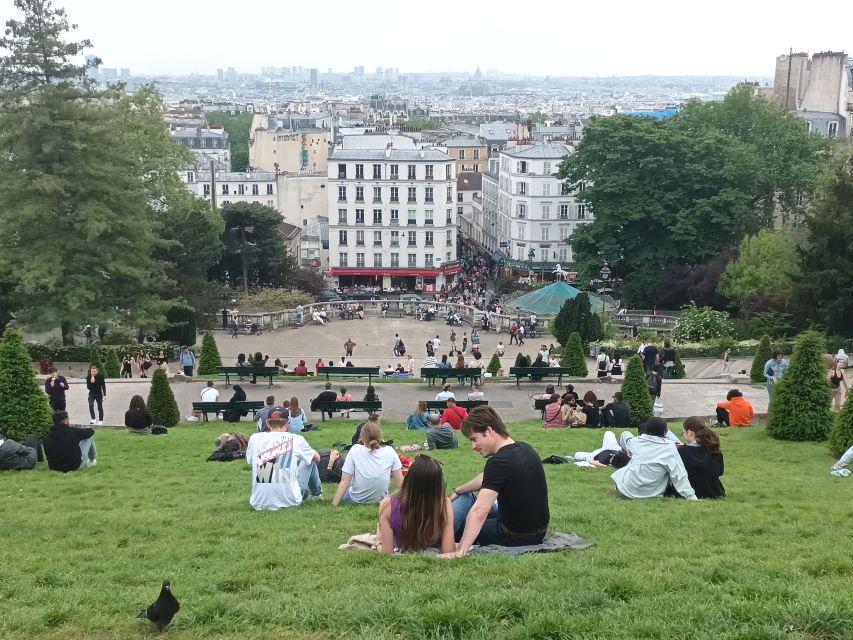
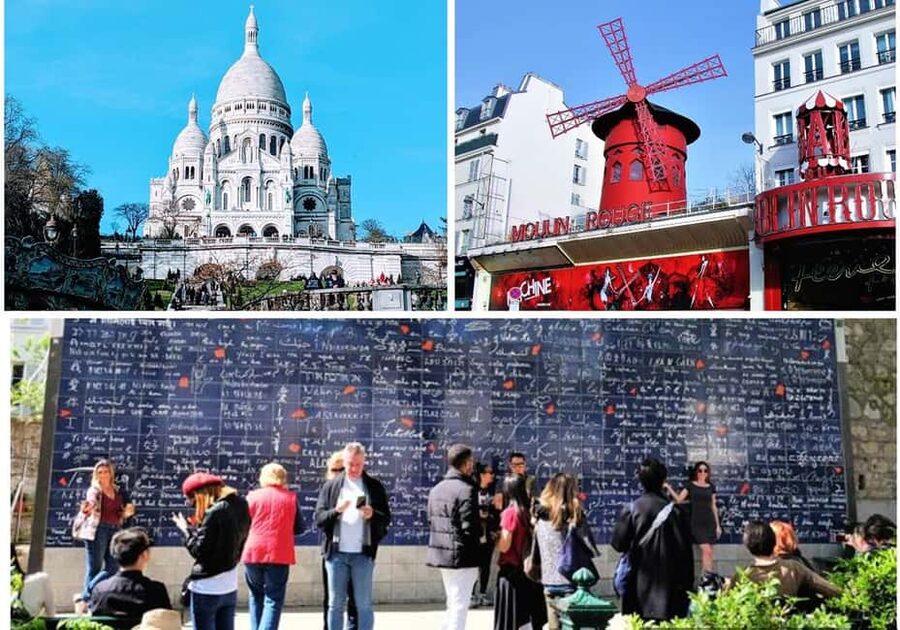
Sacré-Cœur Basilica is your first major stop, and you’ll get a guided visit plus time to wander. Expect the climb to reward you with city views along the way, so even before you reach the steps, you’ll be getting your bearings over Paris.
What I find most valuable here is the way the tour frames the basilica within the Montmartre story. It’s not just a big church on a hill. Your guide ties the setting to the neighborhood’s artistic pull, the kinds of people who gathered here, and how the area’s reputation formed.
You also get some open time at the basilica, so you can do the normal things at a landmark like this, like photos and quiet moments. The only “watch out” is timing and stamina. If you arrive already tired, the walk from Anvers to the top can feel longer than you expect, especially on a cold or rainy day.
Place du Tertre Artists: How Montmartre Performs for Real Life
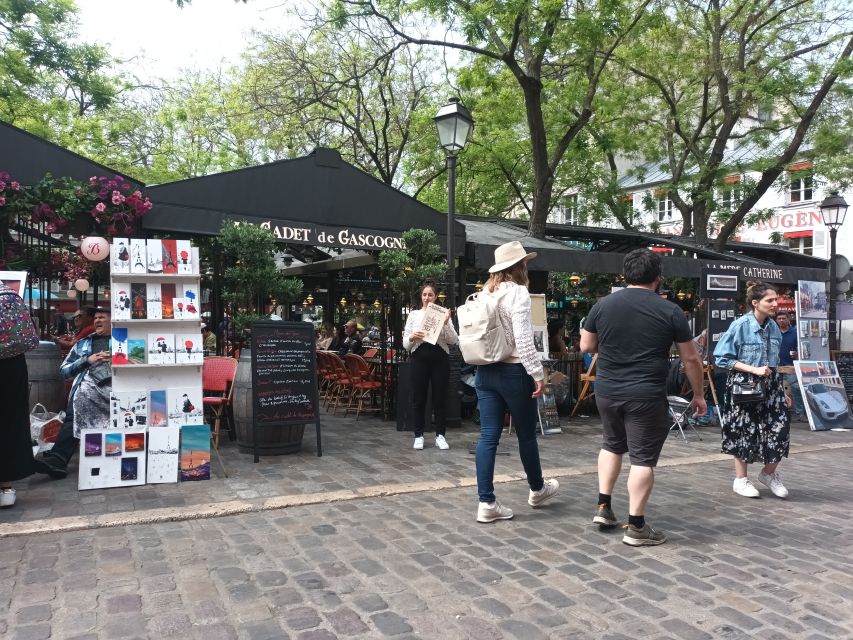
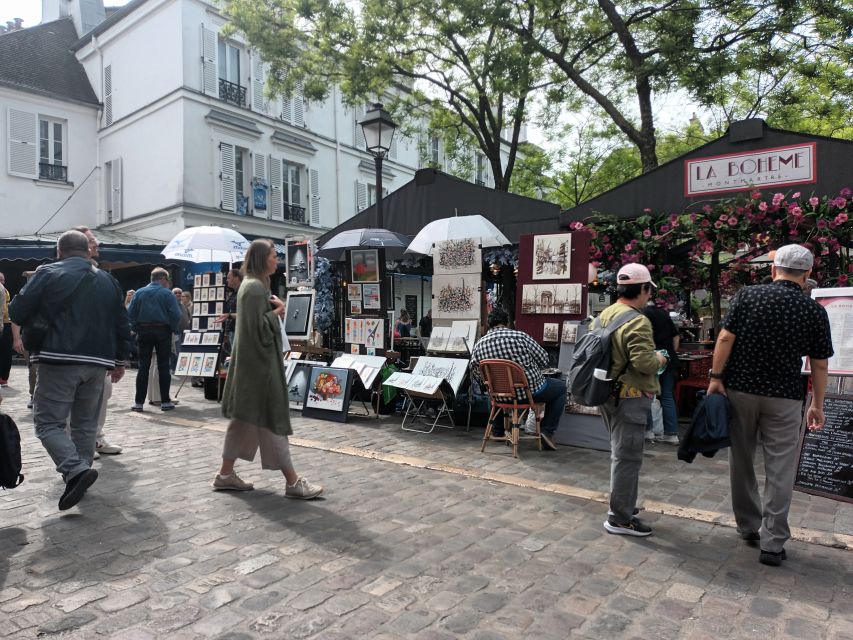
After Sacré-Cœur, you head to Place du Tertre. This is one of those squares that looks like it belongs on a souvenir postcard, with artists setting up to paint. The tour gives you a photo stop, then a short guided walk through the square with time to shop and roam.
The value of a guide at Place du Tertre is that you’re not just looking at stalls. Your guide explains why this square became so closely connected to artists, and you’ll learn the stories behind the painters who lived in the area. That turns the square from a pretty background into a place with a timeline.
Plan your pace. The square can get crowded, and free time means you’ll want to step a little aside to get clear photos. If you’re shopping for prints or small art, this is the moment to do it, not later when you’re pushing toward the finish.
More Walking Tours in Paris
- Paris Top Sights Half Day Walking Tour with a Fun Guide
★ 5.0 · 2,893 reviews - Montmartre Hidden Gems and Scenic Highlights Walking Tour
★ 5.0 · 2,684 reviews - Montmartre Hill French Gourmet Food and Wine Tasting Walking Tour
★ 5.0 · 2,588 reviews
Lapin Agile, Clos Montmartre, and Cabarets That Kept the Creative Engine Running
This is where the tour starts to feel more like “Montmartre as a lived-in neighborhood” and less like “Montmartre as a checklist.”
You’ll pass or stop for sights tied to the area’s creative identity, including:
- Lapin Agile, a classic Montmartre cabaret stop for photos and context
- Vigne du Clos Montmartre, the vineyard where wine is still produced
- The Dalida statue, a quick photo stop that marks how pop culture and Montmartre’s image overlap
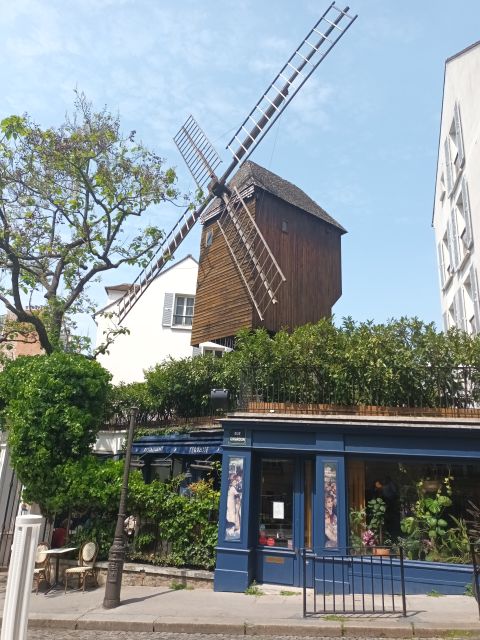
- Moulin de la Galette, another iconic windmill-area landmark for photos
- Le Bateau-Lavoir, where artist connections show up in the streetscape
Your guide also points out places where artists such as Picasso and Van Gogh lived. That detail is useful because it gives you a “where were they, really?” feeling instead of vague art-museum knowledge.
Clos Montmartre is a standout stop for me, because it proves the neighborhood isn’t only about old paintings and theatrical cabarets. It’s also about production and tradition that carried forward. If you like seeing how a neighborhood keeps making things, this vineyard stop is a great reset between the busier squares.
One practical tip: expect short stops, not long museum-style time. Montmartre can move quickly, and this tour keeps you walking between points so you can get the big story. If you want extended interior time, you can plan that as extra time after the tour.
Churches, Streets, and the Art of Explaining What You’re Looking At

Montmartre is packed with religious and architectural landmarks, and the guide approach helps you notice what you might otherwise miss. In past groups, guides have also found time to go inside churches, which is a bonus if your priority is learning how these places function, not just photographing the outside.
A well-run guide is especially helpful on this portion of the walk because you’re surrounded by cues: old facades, corners that look theatrical, and streets that seem designed for stories. The best guides slow you down at the right moments, then give you the reasoning behind what you’re seeing.
Some guides use extra tools, like music on a phone or photo back-up, to help you connect the dots while you’re walking. That sounds small, but it changes everything. It turns a moving lecture into something your brain can actually hold onto, even when you’re bouncing between stops.
Le Mur des Je t’aime and Abbesses: Modern Art in a Very Old Place
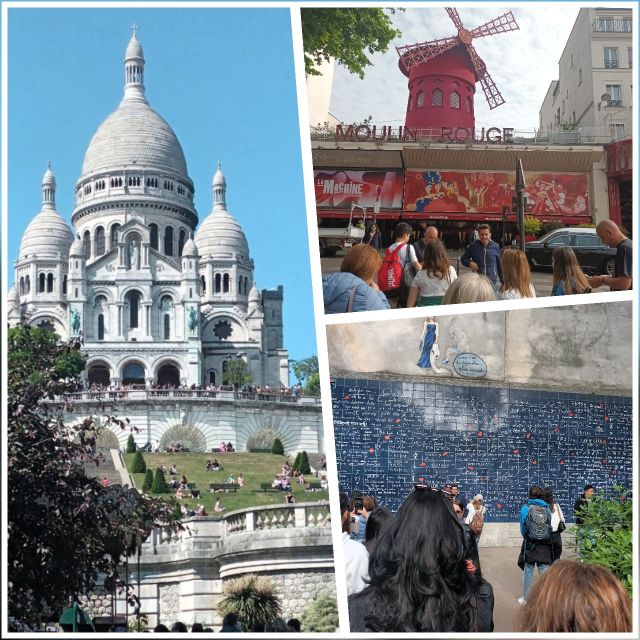
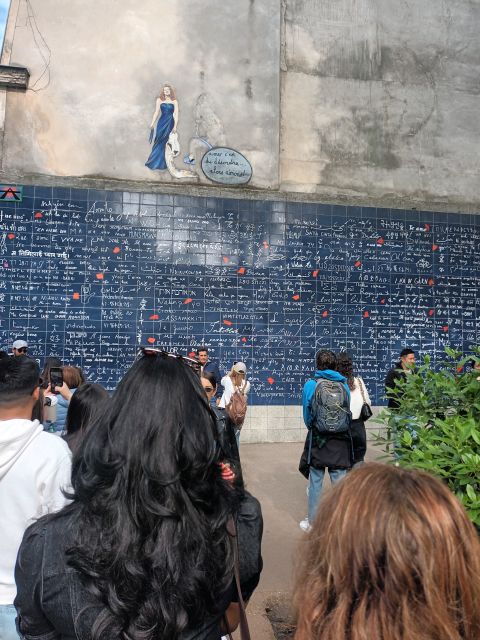
As you move through Abbesses, you’ll see the wall of Je t’aime, a modern art installation that draws plenty of visitors. The tour includes a photo stop and some time to walk and take in the area before heading to the square of Place des Abbesses.
This part of Montmartre matters because it keeps the neighborhood from becoming only a romantic past. You’re still in the “Montmartre world,” but now you’re seeing how modern art and daily life coexist here.
Abbesses itself gives you a different feel than the top-of-the-hill spots. You’ll get a photo stop, guided context, and free time to shop and stroll. It’s a good place to grab a quick snack or a warm drink if you need one, but the tour itself does not include food and drink, so plan on handling that on your own.
More climbs through Montmartre:
Moulin Rouge Finish: A Natural Landing Spot for More Exploration
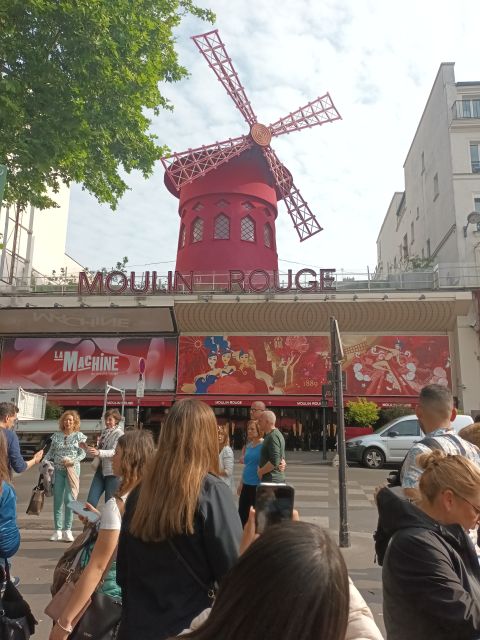
The tour ends at the base of the hill, opposite Moulin Rouge. That finish is smart. You’re not stuck climbing back up or worrying about how to connect to transit with sore legs. Instead, you land in an area where you can keep going, depending on what kind of evening you want.
You’ll have a brief break time at Moulin Rouge for photo ops and some shopping. Then you’re on your own. If you want a slower pace after this, you can simply wander. If you want more structure, you can use the location as a stepping stone to other parts of Paris with an easier route down from the Montmartre heights.
Price and Value: What $74 Buys You on This 150-Minute Walk
At about $74 per person for roughly 2 hours to 150 minutes, this tour is priced for the core things that are hard to DIY well in Montmartre: the big storytelling beats and the timed route through multiple classic and off-the-path locations.
You also get:
- A guided visit at Sacré-Cœur
- A local expert guide
- A small group format that helps the guide keep your attention
- Multiple stops that connect together into one neighborhood narrative
What’s not included is food and drink, and funicular tickets are also not included. That means the cost is mainly paying for the guide, the walking circuit, and the included basilica time. If you were planning to buy funicular rides anyway, you may want to consider whether you want to use the funicular on your return, since the itinerary itself is built around walking the hill.
Is it worth it? If your goal is to understand Montmartre beyond the obvious shots, yes. If your goal is only to take photos at the most famous locations, you might feel like it’s more guide-led than you need. But for most first-timers and repeat visitors alike, this kind of paced explanation is what turns “nice views” into “I get why this place matters.”
Who Should Book This Montmartre Small-Group Walk

This tour is a good fit if you:
- Want Montmartre in a semi-private style with a cap of 8 people
- Like walking and learning at the same time
- Prefer expert guidance that connects art, places, and people
- Want both the famous stops and the quieter streets below them
It is not a good fit if you:
- Need wheelchair accessibility or significant mobility support, because there is a walk up the hill and the tour is not accessible for wheelchairs
- Want a fully sedentary option, since most of the value here comes from moving between multiple sights
If you’re traveling with kids, some guides have been able to keep families comfortable and entertained, and a friendly pace helps. Still, it’s a hill and a walk, so you’ll want to judge based on your group’s stamina.
Should You Book This Tour?
If you want Montmartre to feel understandable and personal, I think this is a strong book. The small group size, the guided storytelling at Sacré-Cœur and Place du Tertre, and the added stops like Clos Montmartre, Lapin Agile, and Le Bateau-Lavoir are exactly the mix that makes a neighborhood tour work.
Skip it only if walking uphill is a deal-breaker for you, or if you prefer to wander without any structure at all. Otherwise, show up at Anvers with comfortable shoes and let the guide do the hard part, turning a steep hill of sights into a coherent Montmartre story you can carry with you after the tour ends by Moulin Rouge.
FAQ
Where does the tour meet?
The guide meets you outside the Anvers metro station, line 2, holding a GetYourGuide sign.
How long is the Montmartre walking tour?
It runs about 2 hours, with a stated range up to 150 minutes.
How big is the group?
This is a small-group tour limited to up to 8 people.
What languages are available for the guide?
You can choose English, Spanish, Italian, or French.
Is Sacré-Cœur Basilica included?
Yes, the tour includes a visit to the Basilica of the Sacred Heart.
What major stops are included?
You’ll see Sacré-Cœur, Place du Tertre, Lapin Agile, Vigne du Clos Montmartre, the Dalida statue, Moulin de la Galette, Le Bateau-Lavoir, the Wall of Je t’aime, Place des Abbesses, and Moulin Rouge.
Does the tour run in bad weather?
Yes. The tour takes place rain or shine.
What should I bring?
Wear comfortable shoes. Dress for the weather and be ready for a walk up the hill.
Are funicular tickets included?
No. Funicular tickets are not included.
Is the tour wheelchair accessible?
No. It is not accessible for wheelchairs and is not suitable for people with mobility impairments.
Boulevard Pace
- Paris Île de la Cité and Notre-Dame Walking Tour With Crypt
★ 5.0 · 2,272 reviews - Paris in a Day: Louvre or Orsay, Eiffel Tower, City Walk & Cruise
★ 5.0 · 1,956 reviews - Paris City Center Free Walking Tour (Tip-Based)
★ 5.0 · 1,340 reviews - Paris: Dark History and Ghostly Guided Walking Tour
★ 4.7 · 1,000 reviews
Latest Paris entries, notes attached






Montmartre Walks, compared.

Montmartre Hidden Gems and Scenic Highlights Walking Tour
Read our review →
Montmartre Hill French Gourmet Food and Wine Tasting Walking Tour
Read our review →
Montmartre Highlights Walking Tour with a Local Guide
Read our review →
Montmartre Cheese, Wine & Pastry Guided Walking Tour
Read our review →
Sacré-Coeur and Montmartre Tour with Expert Guide
Read our review →
Private Montmartre Food Tour with Wine, Cheese & Pastries
Read our review →
Paris Montmartre Food Tour – A Full French Meal by Do Eat Better
Read our review →This tour also appears in